

When Enterprise Systems Go Headless, Change Becomes the New Control Plane

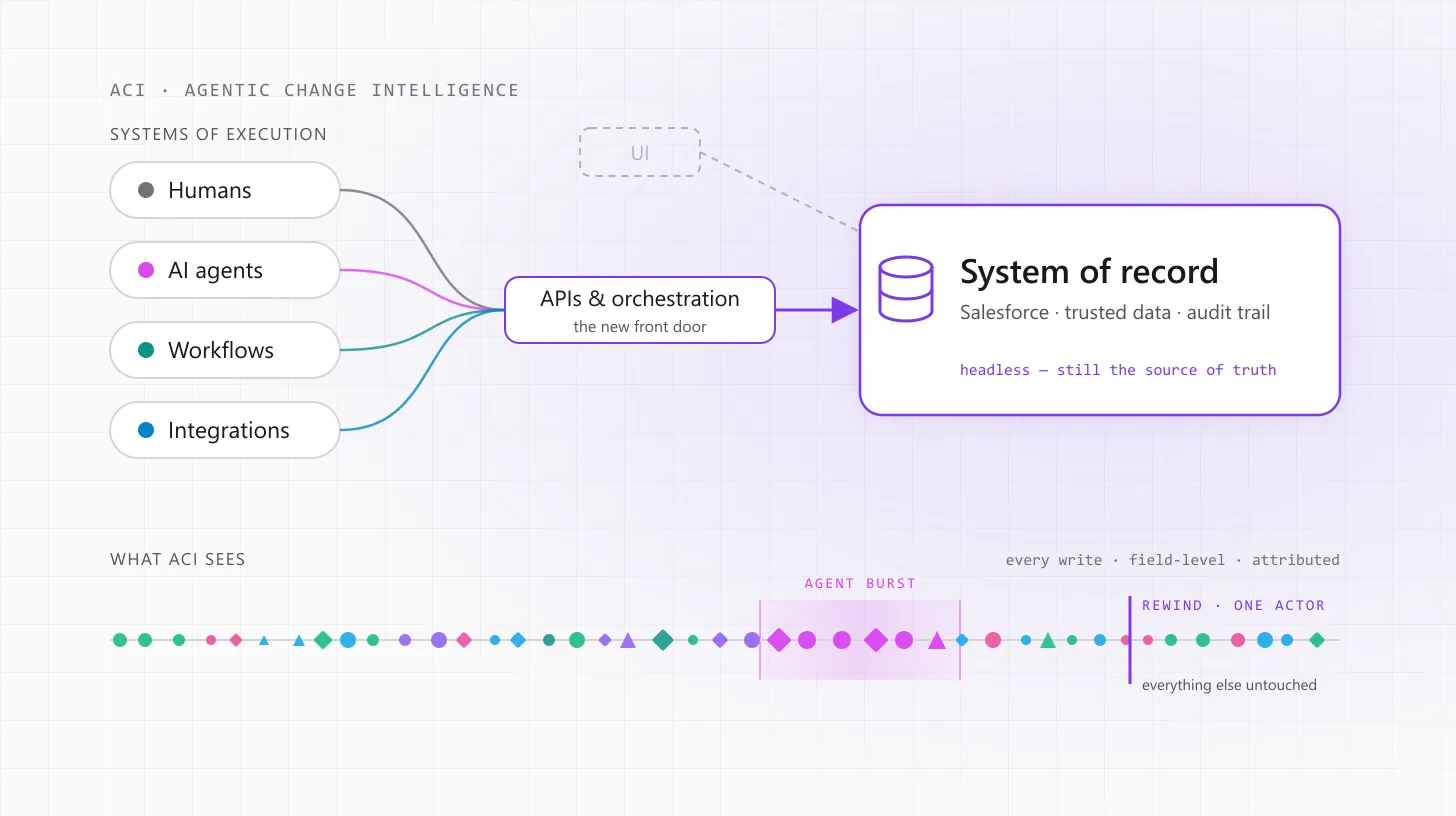
Enterprise software is entering a fundamental shift.
For years, SaaS applications were built around human users. People logged into an application, navigated its interface, executed workflows, and reviewed the results. But with the rapid adoption of AI agents, that model is changing. Increasingly, SaaS platforms will remain the systems of record, while AI agents and orchestration platforms become the systems of execution.
The application does not disappear. It becomes headless.
Instead of hundreds of users interacting directly with Salesforce or other enterprise systems, a growing share of activity will happen through agents, APIs, integrations, automations, and workflows. The traditional UI becomes less important while the orchestration layer coordinates activity across multiple systems. This is the evolution from individual, task-oriented AI toward team-based AI operating through agentic workflows.
Headless execution creates a new kind of complexity
This shift increases speed and automation — but it also creates a visibility and control problem.
When a human changes 20 Salesforce records, the activity is relatively easy to understand. When several AI agents, workflows, integrations, and humans simultaneously make thousands of changes across the same business data, answering basic questions becomes much harder:
- What changed?
- Who — or what — made the change?
- Why did it happen?
- Which agent was responsible?
- What other records were affected?
- And can we safely reverse that activity without undoing valid work performed by someone else?
Traditional application logs and user interfaces were not designed for this operating model. Yet governance, auditability, permissions, and compliance become even more important as agents begin executing business processes directly. That is exactly the tension: systems of record remain valuable precisely because of their trusted data, business logic, governance, and audit trails.
ACI brings observability and control to the headless enterprise
ACI — Agentic Change Intelligence — provides the change intelligence layer for this new environment.
ACI captures changes made by humans, AI agents, workflows, automations, and integrations, attributes every change to its actor, and reconstructs how activity evolved over time.
Organizations can analyze agent behavior, investigate unexpected activity, understand the impact of automated workflows, and take control when something goes wrong — including reversing the work of a specific actor without disturbing unrelated changes.
As enterprise systems become increasingly headless, visibility can no longer stop at the user interface.
The future of governance is understanding the activity happening underneath it.
ACI is built by AI Wind for enterprises putting agentic solutions into production on Salesforce. See it against your own org.